
Maslow’s Hierarchy of Needs: What It Is & How It Applies to Education
In the field of education, academic success matters enormously – but students cannot thrive in their learning unless their deeper human needs are first being met. This is the central insight behind Maslow’s Hierarchy of Needs, one of the most widely recognised frameworks in psychology and education.
Whether you are a teacher, assessor, or pursuing an education qualification, understanding Maslow’s Hierarchy of Needs can transform the way you support your learners. In this guide, we explain the theory in full, explore how each level applies to education, and offer practical approaches for putting it into practice in the classroom or training environment.
Who Was Abraham Maslow?
Abraham Maslow (1908 – 1970) was an American psychologist who developed his now-famous hierarchy in 1943. The theory was published in a paper called ‘A Theory of Human Motivation‘. Maslow was interested in understanding what drives human behaviour. Not just in terms of basic survival, but in terms of personal growth and fulfilment.
Rather than studying people who were struggling, Maslow studied individuals he considered to be thriving. This included Albert Einstein and Eleanor Roosevelt. This study covered what conditions had allowed them to reach their potential. His conclusion was that human needs operate in a hierarchy: lower-level needs must be reasonably satisfied before a person can focus on higher-level ones.
The Five Levels of Maslow’s Hierarchy
Maslow’s model is most commonly represented as a pyramid with five tiers, moving from the most fundamental needs at the base to the most aspirational at the top. 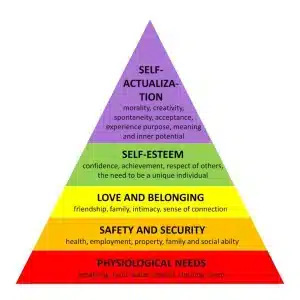
Physiological Needs
At the base of the pyramid are physiological needs. These are the biological requirements for human survival, including food, water, shelter, sleep, warmth, and clothing. Without these basics in place, nothing else is possible. A person who is hungry, exhausted, or cold cannot focus on much beyond meeting those immediate needs.
In an educational context, this level is more relevant than many educators might initially assume. Students dealing with food insecurity, inadequate housing, or poor sleep are physiologically compromised before they even walk through the door.
Safety Needs
Once physiological needs are met, the next level concerns safety and security. This includes physical safety, financial stability, health, and protection from harm. For students, safety needs extend beyond avoiding physical danger — think emotional safety, predictability, and a sense of stability in their environment.
A student who feels anxious, threatened, or uncertain in their learning environment will struggle to engage meaningfully with content, regardless of how well it is taught.
Love and Belonging Needs
Human beings are fundamentally social creatures. Once safety is assured, people seek connection. Meaningful relationships, a sense of belonging to a group, and feelings of acceptance and love. In educational settings, this translates to students feeling welcomed, valued, and connected to their peers and tutors.
Isolation, social exclusion, or feeling like an outsider in a learning environment are significant barriers to engagement and progress.
Esteem Needs
The fourth level includes both self-esteem (feeling confident, competent, and worthy) and the esteem of others (recognition, respect, and acknowledgement). Learners who feel capable and appreciated are far more likely to take risks, embrace challenges, and persist when things get difficult.
Learners with low self-esteem or who feel undervalued will often disengage, avoid participation, or give up at the first sign of difficulty.
Self-Actualisation
At the top of the pyramid sits self-actualisation. Self-actualisation is the realisation of one’s full potential. Maslow described this as the desire to become the most that one can be: pursuing personal growth, creativity, purpose, and meaning. In education, self-actualisation looks like a learner who is genuinely engaged, intrinsically motivated, and pursuing their learning because it connects to something they care deeply about.
It is worth noting that Maslow did not see self-actualisation as a permanent destination, but as an ongoing process of growth and becoming.
Why Does Maslow’s Theory Matter for Educators?
The practical implication of Maslow’s hierarchy is straightforward but profound. If you want learners to engage deeply with their learning, you need to pay attention to the conditions that make that engagement possible.
A learner who hasn’t eaten, who feels unsafe in the classroom, who has no friends on their course, or who believes they are stupid will not be able to self-actualise – no matter how good the teaching is. Understanding this shifts the educator’s role beyond simply delivering content and into actively creating the conditions for learning to happen.
Applying Maslow’s Hierarchy in Education: Practical Approaches
Addressing Physiological Needs
Before learners can engage with the learning process, their basic physical needs must be reasonably met. While educators cannot solve poverty or housing insecurity, there are practical steps institutions can take:
- Ensuring learners know about any available financial support
- Providing comfortable, well-lit, well-heated learning spaces
- Allowing breaks for water, food, and rest during longer sessions
- Being aware that early morning or evening learners may be more fatigued and adjusting expectations accordingly
Being attentive to these needs is not about lowering standards, it is about removing unnecessary barriers to participation.
Creating a Safe Learning Environment
Physical safety is rarely the primary concern in most educational settings, but emotional safety is a different matter. Learners – especially adults returning to education after difficult experiences – often carry significant anxiety about failure, humiliation, or being judged.
Educators can build psychological safety by:
- Setting clear, consistent behavioural expectations from the outset
- Responding to mistakes with curiosity rather than criticism
- Never allowing ridicule or dismissiveness from themselves or from other learners
- Addressing conflict or bullying promptly and seriously
- Being consistent and predictable, so learners know what to expect
When learners feel safe to make mistakes, ask questions, and take risks, the quality of their engagement improves dramatically.
Fostering a Sense of Belonging
Belonging is often underestimated as a factor in learning outcomes. Learners who feel part of a community, who have relationships with their peers and who feel seen and valued by their tutor, perform better and persist longer.
Practical ways to foster belonging include:
- Learning and using learners’ names from the very first session
- Creating structured opportunities for learners to get to know one another
- Celebrating diversity and making the learning environment genuinely inclusive
- Checking in regularly with quieter learners who may be struggling to connect
- Building a collaborative rather than competitive classroom culture
For assessors working with learners one-to-one or in small groups, the quality of the relationship with the individual learner is especially significant. A warm, respectful, professional relationship lays the foundation for everything else.
Promoting Self-Esteem and Confidence
Esteem needs are particularly relevant for assessors and teachers, because assessment itself is one of the most powerful tools for either building or undermining learner confidence.
Feedback that is honest, specific, constructive, and framed around growth can have a transformative effect on a learner’s self-belief. Feedback that is vague, overly critical, or delivered without care can do lasting damage. For those undertaking an assessor qualification, understanding how to give high-quality feedback that supports esteem is one of the most important skills to develop.
Additional ways to support learners’ esteem:
- Recognising effort and progress, not just achievement
- Setting tasks that are challenging but achievable – small wins build confidence
- Inviting learners to reflect on their own strengths
- Avoiding comparison between learners
- Adopting a growth mindset approach — framing ability as something developed through effort, not fixed at birth
Encouraging Self-Actualisation
Self-actualisation cannot be manufactured, but it can be cultivated. The conditions that support it include autonomy, creativity, choice, and a sense of personal meaning in what is being learned.
Educators can encourage self-actualisation by:
- Giving learners agency where possible – in the topics they explore, the methods they use, or the way they demonstrate their learning
- Connecting learning to learners’ own goals, values, and interests
- Encouraging creativity and original thinking rather than just correct answers
- Using project-based learning that allows learners to pursue questions they genuinely care about
- Asking learners to reflect on their learning journey and what it means to them
Common Challenges and How to Address Them
When Basic Needs Are Not Being Met
Some learners face genuine hardship that extends well beyond what an educator can solve alone. Food insecurity, unstable housing, and mental health crises are realities for a significant proportion of adult learners. Educators should know what support services are available and how to refer learners to them discreetly. Creating a classroom culture where asking for help is normalised rather than stigmatised makes it more likely that learners in need will actually seek support.
When Learners Feel Emotionally Unsafe
If learners do not feel safe in the learning environment, they will often disengage rather than speaking up. Regular, low-stakes check-ins, even a simple “how are you finding things?” can surface problems early. Ensuring your setting has clear anti-bullying and safeguarding policies that are actually implemented, not just written down, is essential.
When Belonging Is Fragile
In cohorts where learners come from very different backgrounds, fostering belonging takes deliberate effort. Activities that surface common ground, inclusive language, and explicit celebration of diversity all contribute. Be especially attentive to learners who appear isolated, they may not flag the issue themselves.
When Confidence Is Low
Low confidence is extremely common among adult learners, particularly those who had negative experiences of school. Meeting learners where they are, recognising every step of progress, and creating an environment where struggle is seen as a normal part of learning, rather than evidence of inadequacy, makes a significant difference over time.
When Learners Are Going Through the Motions
Some learners complete their qualifications without ever really engaging with the deeper purpose of their learning. If self-actualisation feels out of reach, it is often because earlier needs have not been adequately met. It may also be because the relevance of the learning to the learner’s own life has never been established. Taking time at the start of a programme to understand each learner’s goals, and returning to those goals throughout, helps keep learning meaningful.
The Ongoing Relevance of Maslow’s Theory
It is worth acknowledging that Maslow’s hierarchy has been critiqued over the decades. Some researchers argue that the rigid pyramid structure does not reflect how needs actually interact in real life — that people can pursue self-actualisation even when lower needs are not fully met, or that the priority of needs varies significantly across different cultures and individuals.
These are fair points. Maslow’s hierarchy is best understood as a useful conceptual framework – a lens for thinking about what learners need – rather than a precise scientific model. Used thoughtfully, it draws educators’ attention to the full range of factors that affect learning, and encourages a more holistic approach to supporting learners.
Developing Your Practice as an Educator
Understanding Maslow’s hierarchy is a strong foundation, but translating it into consistently excellent practice requires ongoing professional development. Reflective practice – regularly asking yourself how well you are meeting learners’ needs at each level – is one of the most powerful tools available to any educator.
If you are looking to build on your knowledge and develop your skills as an educator or assessor, explore our range of teaching and assessing qualifications, including the AET qualification, CAVA qualification, and our CPD courses for educators.
If you have any questions about becoming a qualified teacher or assessor, our team is always happy to help. You can reach us at training@brooksandkirk.ac.uk or call us on 01205 805 155.