Bloom’s Taxonomy Explained: A Practical Guide for Educators
Bloom’s Taxonomy is one of the most widely used frameworks in education and training. If you’ve ever written a learning objective, designed an assessment, or planned a lesson, there’s a good chance it has shaped how you did it, even if you didn’t realise it at the time.
So what exactly is it? This guide explains what Bloom’s Taxonomy is, where it came from, how the six levels work, and how to use it in practice; whether you’re a teacher, trainer, assessor, or studying for a teaching qualification.
What Is Bloom’s Taxonomy?
Bloom’s Taxonomy is a framework for classifying learning objectives. It organises thinking skills into a hierarchy, from basic recall of facts at the bottom, to creating something new at the top.
The core idea is simple. Learning is a progression. You can’t apply knowledge you haven’t understood. You can’t evaluate something you haven’t learned to analyse. So the taxonomy gives educators a structured way to think about what they want learners to do, and at what level of depth.
Because of this, educators use Bloom’s Taxonomy to write learning objectives, design assessments, plan lessons, and build courses across every sector of education and training.
Who Developed Bloom’s Taxonomy?
Educational psychologist Benjamin Bloom developed the taxonomy alongside a committee of educators at the University of Chicago. They published it in 1956. The aim was practical — to give educators a shared language for talking about what learners should be able to do.
However, the taxonomy didn’t stay unchanged. In 2001, Lorin Anderson and David Krathwohl, former students of Bloom, revised it. They updated the language from nouns to verbs and made one key structural change. The original top two levels, Synthesis and Evaluation, were reversed and renamed Create and Evaluate. As a result, the revised version is now the one most educators use today.
The Original vs the Revised Taxonomy
It’s useful to know the difference between the two versions, as both appear in the literature.
- Original (1956): Knowledge ? Comprehension ? Application ? Analysis ? Synthesis ? Evaluation
- Revised (2001): Remember ? Understand ? Apply ? Analyse ? Evaluate ? Create
The revised version is more widely used today. However, the underlying principle is the same in both — learning moves from simple to complex, and from concrete to abstract.
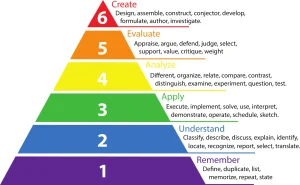 The Six Levels of Bloom’s Taxonomy
Here’s a breakdown of each level, what it means, and the action verbs that go with it. These verbs are important because they help educators write clear, measurable learning objectives.
1. Remember
At this foundational level, learners recall facts, definitions, and basic information. There’s no need to understand or apply it — just to retrieve it.
Examples of what this looks like:
- Listing the stages of a process
- Naming key terms or definitions
- Reciting facts from memory
Action verbs: define, list, recall, name, identify, state, memorise, repeat
2. Understand
At this level, learners show they grasp the meaning of information — not just that they can recall it. So they can explain ideas in their own words, summarise what they’ve learned, or describe what something means.
Examples of what this looks like:
- Explaining a concept to someone else
- Summarising a process in their own words
- Describing the purpose of a piece of legislation
Action verbs: explain, describe, summarise, interpret, classify, paraphrase, compare, discuss
3. Apply
At this level, learners use their knowledge in a real situation. They take what they’ve understood and put it into practice.
Examples of what this looks like:
- Carrying out a skill in a workplace setting
- Using a theory to solve a problem
- Completing a task using a procedure they’ve learned
Action verbs: apply, use, demonstrate, carry out, implement, execute, solve, practise
This level is especially relevant in vocational training. Because learners must show competence in real workplace settings — not just show they understand theory — Apply is where much of vocational assessment happens.
4. Analyse
At this level, learners break information into parts and explore how those parts connect. So they start to think critically rather than just absorb and apply.
Examples of what this looks like:
- Identifying the strengths and weaknesses of X, Y and Z
- Breaking down a case study to find the root cause of a problem
- Comparing two approaches and examining the differences
Action verbs: analyse, compare, differentiate, examine, break down, distinguish, investigate, categorise
5. Evaluate
At this level, learners make judgements based on evidence and reasoning. They don’t just describe or analyse — they form and defend a view.
Examples of what this looks like:
- Judging whether a decision meets the required standard
- Reviewing a learner’s portfolio against set criteria
- Recommending an approach and explaining why it’s the best option
Action verbs: evaluate, judge, justify, critique, assess, argue, defend, recommend, prioritise
This level maps closely onto what assessors and IQAs do every day. Because assessment involves evidence-based judgement — not just knowledge — it sits firmly at the Evaluate level.
6. Create
At the top of the taxonomy, learners use everything they know to produce something new. They combine ideas, design solutions, or build something original.
Examples of what this looks like:
- Designing a new assessment plan for a learner
- Developing a scheme of work for a training programme
- Writing a quality assurance policy from scratch
Action verbs: create, design, develop, produce, construct, formulate, plan, compose, generate
The Three Domains of Bloom’s Taxonomy
The six levels above relate to the cognitive domain — thinking and knowledge. However, Bloom’s original framework also covered two other domains.
- The Cognitive Domain covers intellectual skills and knowledge. This is the domain most people mean when they talk about Bloom’s Taxonomy.
- The Affective Domain covers attitudes, values, and emotional responses to learning. It ranges from simply being aware of something at the lowest level, to making it a core part of one’s values at the highest.
- The Psychomotor Domain covers physical skills and practical performance. This domain is central to vocational education and training, where learners must demonstrate hands-on competence.
In practice, most educators focus on the cognitive domain. However, all three matter. Because learners need knowledge, positive attitudes, and practical skills to be truly competent in their field.
How to Use Bloom’s Taxonomy in Practice
Understanding Bloom’s Taxonomy is one thing. Using it well is another. Here’s how it applies day-to-day.
Writing Learning Objectives
The most common use of Bloom’s Taxonomy is writing learning objectives. A good objective uses a specific action verb that tells learners exactly what they’ll be able to do — and at what level of thinking.
For example:
- “Learners will know about assessment methods” — vague and not measurable
- “Learners will be able to compare two assessment methods and justify which is most appropriate for a given context” — specific, measurable, and pitched at the Analyse and Evaluate levels
So by choosing verbs from the right level of the taxonomy, you make your objectives clear and aligned to the depth of learning you want.
Designing Assessments
Bloom’s Taxonomy helps ensure that assessments match learning objectives. If your objective sits at the Apply level but your assessment only tests Remember and Understand, you’re not actually assessing what you set out to teach.
In vocational education, this matters a great deal. Because competence-based assessment must reflect real workplace performance — which sits at Apply, Analyse, and Evaluate — not just knowledge recall.
Planning Lessons and Training Sessions
The taxonomy also gives a useful structure for sequencing learning. Start sessions at the lower levels — building knowledge and understanding — then move learners gradually towards application, analysis, and evaluation.
For example, a session on feedback might begin by asking learners to recall the principles of good feedback (Remember), then explain why feedback matters (Understand), then practise giving feedback (Apply), before evaluating a sample piece of feedback and suggesting improvements (Evaluate).
This step-by-step approach ensures learners build on solid foundations before tackling more complex tasks.
Bloom’s Taxonomy and Vocational Education
Bloom’s Taxonomy is especially relevant in vocational education — more so than many educators realise.
Because vocational qualifications assess real workplace competence, they naturally draw on the middle and upper levels of the taxonomy. An assessor watching a learner in the workplace assesses at the Apply level. An IQA judging whether an assessor’s decision meets the required standard works at the Evaluate level. A trainer designing a new programme works at the Create level.
Understanding this helps vocational educators plan more deliberately. Rather than defaulting to knowledge-based activities, which sit at the Remember and Understand levels, they can design learning that prepares learners for the real complexity of professional practice.
For those studying the Level 3 Award in Education and Training (AET), Bloom’s Taxonomy is a key concept. It shapes how you write session plans, design activities, and set outcomes that are clear, measurable, and right for the level of your learners.
Similarly, for assessors working towards the CAVA qualification, Bloom’s Taxonomy helps you think carefully about the level of thinking your assessment methods are actually testing and whether that matches the competence you’re trying to confirm.
Bloom’s Taxonomy and Maslow’s Hierarchy of Needs
Bloom’s Taxonomy is often discussed alongside Maslow’s Hierarchy of Needs — and the two work well together.
Maslow’s hierarchy explains the conditions learners need before meaningful learning can happen. Bloom’s Taxonomy explains the levels of learning that become possible once those conditions are met.
In other words: Maslow tells you what learners need to feel ready. Bloom tells you what to do with them once they are. Together, they give educators a more complete picture of how to support learners, from creating the right environment to designing the right experiences.
Criticisms of Bloom’s Taxonomy
Like Maslow’s hierarchy, Bloom’s Taxonomy has faced criticism over the years. It’s worth being aware of these.
The hierarchy isn’t always linear. Some researchers argue that higher-order thinking doesn’t always depend on lower-order skills being mastered first. For example, creativity can sometimes drive understanding rather than follow from it.
It focuses mainly on the cognitive domain. Despite the existence of affective and psychomotor domains, the cognitive domain dominates most practical applications. As a result, educators can undervalue emotional engagement and practical skill development.
It can oversimplify learning. Reducing all learning to six levels may not capture the full complexity of how people actually develop expertise.
However, these criticisms don’t cancel out the value of the framework. Used thoughtfully — as a guide rather than a rigid rule — Bloom’s Taxonomy remains one of the most practical tools available to educators and trainers.
Developing Your Practice as an Educator
Understanding Bloom’s Taxonomy is a strong foundation. However, knowing how to apply it consistently in lesson planning, assessment design, and learner support is a skill that grows over time.
If you want to formalise your teaching skills, our Level 3 Award in Education and Training (AET) covers a full introduction to teaching in the further education and training sector. It’s ideal for professionals who already have expertise in their field and want to develop as educators.
For qualified assessors looking to build on their practice, our CAVA and IQA qualifications take assessment design and quality assurance further — drawing on frameworks like Bloom’s Taxonomy to sharpen how you plan, carry out, and evaluate assessment.
Find out more about the AET qualification here. Explore our CAVA and IQA courses here.
If you have questions about which course suits you best, our team is happy to help. Email us at training@brooksandkirk.ac.uk or call 01205 805 155.